Kent Remembers: Ernest Simpson
Friday 1st November 2024

Born: 17.12.1875, Clapton, Essex. Died: 2 .10.1917, St Omer, France.
Kent: 1896.
Ernest Simpson’s short career with Kent was unusual in that he joined the team for the first match of the 1896 season, remained in the side for the next seven matches and, it seems, never played serious cricket again apart from a few games for Malvern Wanderers.
A contemporary at Malvern of ‘Pinky’ Burnup and ‘Tip’ Foster, he was playing for Malvern from 1893 to 1895, captain in his final season. In 1894 Lillywhite described him as ‘a batsman of the stone-wall type with a rather clumsy style’ but ‘a good field’. By his final season he had progressed to having ‘shown great defensive powers and saved his side from defeat on more than one occasion’. ‘He knows the game and has proved an excellent captain’.
He made his Kent debut the year after leaving Malvern and did so in the company of Charles Osborn Cooper, who had married one of his four sisters. On his debut, he improved on a first innings duck with 17 in the second innings and followed it at Old Trafford with a gritty 94 out of 234, scored against Arthur Mold and Johnny Briggs at their best. Moving on to Headingley, he was run out for 29, ending a 72-run second-wicket partnership with Jack Mason (50). In the next match, at Edgbaston, he was top scorer with 37 in Kent’s second innings. In his remaining six innings, against on the whole weaker opposition, there were two ducks and a top score of 13.
The son of a stockbroker, Ernest Simpson settled in Beckenham and spent the remainder of his working life on the Stock Exchange, latterly specialising in the US market. On the outbreak of war he was over the original age limit for enlistment but, with conscription looming, the limit was raised and on December 7th, just short of his 40th birthday, he enlisted as a private in the Army Reserve. It was May 1916 before he was actually called-up and in June he was accepted as an Officer-Cadet and enrolled for a Royal Garrison Artillery Anti-Aircraft training course. Commissioned in August as a Temporary Second Lieutenant, in October he was posted to France with 201st (AA) Section RGA.
In December he was transferred to the 29th Section (AA), equipped with the new three-inch (76.2 mm.) mobile anti-aircraft gun, a gun which was still in service with the BEF in 1940. In August 1917 he was transferred to G Battery, RGA attached to the ANZC Corps, Second Army. On 27 September 1917, during an air raid he was severely wounded by a bomb near Vlamertinghe and died of his wounds in hospital at St Omer.
He is buried at Longue (St Omer) Cemetery, Grave Number lVE21.
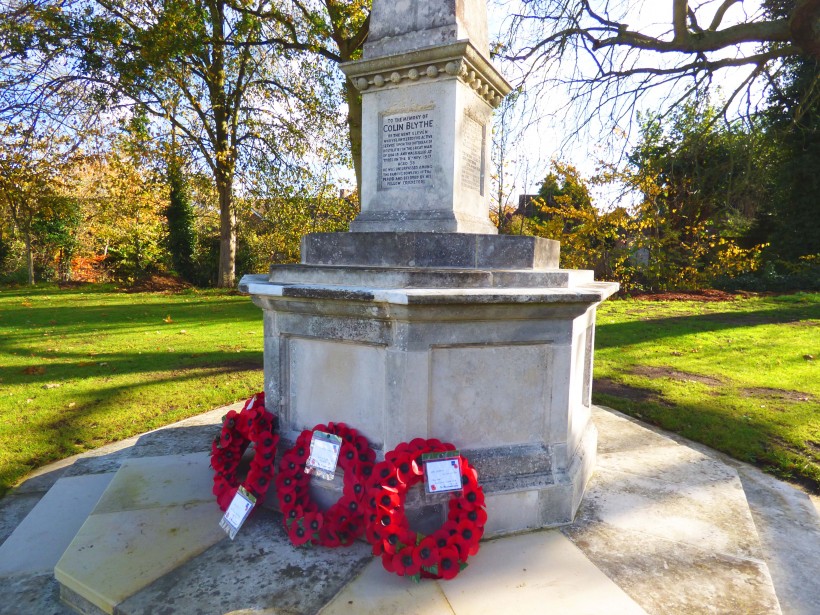
His estate was valued at £7,845.1s. 6d. Probate was granted to his widow, Mabel Violet (née Bishop) whom he married at Holy Trinity Church, Sloane Square in 1913. Ernest Simpson’s obituary appeared in The Times but, possibly because he was serving with the Australians, his name does not appear in the Roll of Honour in the Kent History nor did his obituary appear in Wisden. His name was added to the War Memorial at The Spitfire Ground, St Lawrence after the other World War One casualties.
Profile adapted from Derek Carlaw’s ‘Kent County Cricketers: A to Z, 1806-1914’
Read more about some of the Kent cricketers that gave their lives in War via the Club’s Kent Remembers page below:
Kent Remembers